

St Faiths Cemetery graves of interest
If you have found the grave of an ancestor in one of the Havant cemeteries and you have information that may be of interest to other people, please tell us using the Contact form and we will add it to this page.
The Bannister Family
There is a vault for the parents and an adjacent headstone for two of the sons in the New Lane section and a grave for the two daughters in the Eastern Road section.

Bannister Vault

Adjacent headstone for two of the sons.

Bannister grave in Eastern Road section.
Click on the button for more information
Chignell Family

Chignell Grave

1891 England Census for Alfred Chignell.

1911 England Census for Thomas Alexander Chignell.
Click on the button for more information
Eldred Family

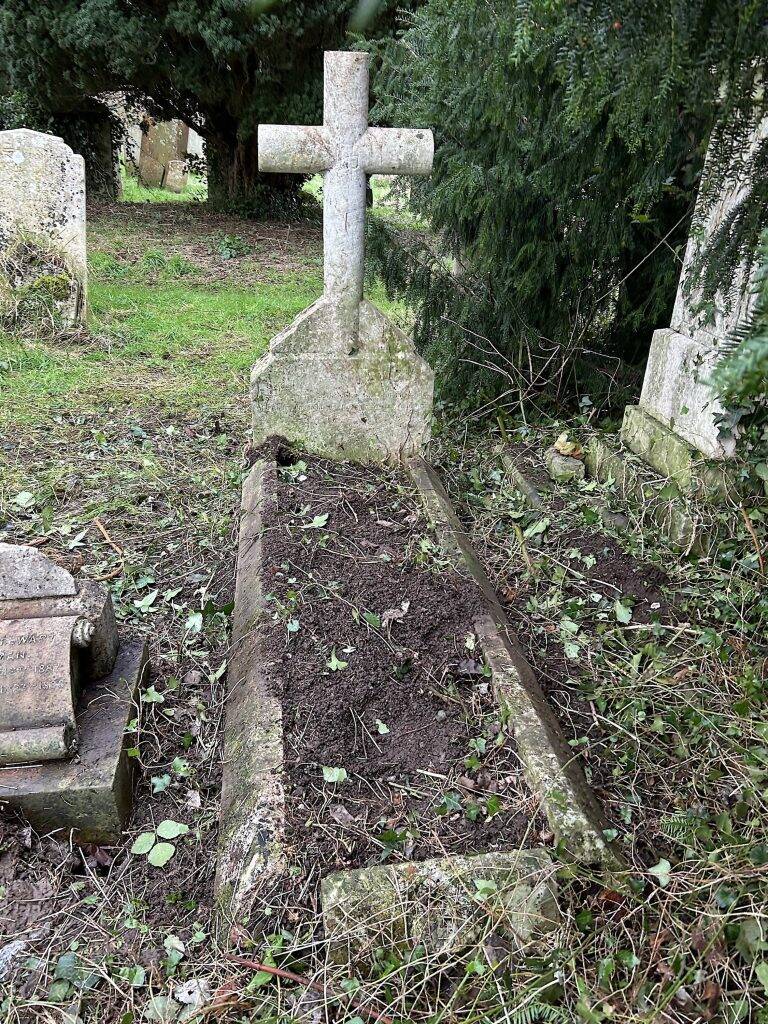
The grave of George Eldred (1837 - 18.08.1874) and his wife Sarah (23.10.1843 - 06.03.1872) is in the St Faith's section, in the same row as the two Bannister tombs and the Chignell grave. They are all at the eastern end of the outline of the old chapel.
The Eldreds didn't live in Havant for very long. They married in Launceston, Tasmania (Sarah's birthplace) in 1866 and their first child, Beatrice was born there on July 25th 1868. They returned to England, where their son Herbert was born in Ramsey, Huntingdonshire (George grew up there) on 1st July 1870.
In the 1871 Census they are living at 10 East, Havant (London House) with George's occupation listed as Draper. Sarah died in Havant the next year and was buried on the 12th March. Later that year George married Susan May King at St George's, Hanover Sq, Westminster on November 29th. Susan was born in Oving,near Chichester in 1849 and in 1871 had been living with her parents and siblings in Orchard St, Chichester.
Susan and George had two daughters, Peachy Mary born on the 19th January 1873 and registered in Portsea Island. Peachy was christened in Chertsey, Surrey indicating they may have lived there for a while. Their second daughter Elfrida Lilian was born in Havant in the second quarter of 1874. Shortly before George's death in August and burial on the 22nd. His probate record does not give a specific address. Susan's name is on the headstone but she is not buried there.
To find out what happened to Susan and the children thereafter, click on the link below
Click on the button for more information

Granville Family

Granville-tomb
As well as the two daughters whose tomb we are aware of, the eldest Granville daughter, Georgiana Pigott, is buried somewhere in the New Lane section too. Additionally, so are two of their maternal aunts, Anne Hinchliff is one; the other is Katherine Mountain. Katherine’s husband George Robert Mountain who was rector of St Faith’s from 1825 to 1846 is buried in St Faith’s churchyard.
Click on the button for more information
Grace Catherine Horril
In the 1891 Census Grace Catherine Horril was the matron at the Union Workhouse in West St and her husband was the Workhouse Master. Prior to her marriage Grace had been a school mistress at Milton Workhouse in Kent in 1871 and at Ashton under Lyme Workhouse in 1881. Her grave is below a small tree close to the Dissenters’ boundary wall.

Grace Catherine Horril headstone
In the 1891 Census Grace Catherine Horril was the matron at the Union Workhouse in West St and her husband was the Workhouse Master. Prior to her marriage Grace had been a school mistress at Milton Workhouse in Kent in 1871 and at Ashton under Lyme Workhouse in 1881. Her grave is below a small tree close to the Dissenters’ boundary wall.
Cecil Stewart Norman

Cecil-Stewart-Norman
This small memorial is alongside another grave which does not appear to be related in any way. It’s on the left as you approach the line of tombs and vaults.
Cecil Stewart Norman was the son of Cicely Edith Longroft and her husband Stewart Norman. He was born 12th December.1887 and died 23rd March 1888. Cicely was a daughter of Charles John Longcroft and his wife Mary whose tomb is nearby.
Preston Watson

Preston Watson was born in Hougham, Lincolnshire in 1842, the third son of Joseph Watson and Elizabeth Parker. He was still living there in 1851 but in 1861 was working as a butler in a nearby village. In 1871 he was still working as butler but now for a household near Christchurch, Hants.In 1876 he married Elizabeth Jenkins at Christ Church, Rotherhithe on April 28th. His occupation recorded as Licensed Victualler. Elizabeth was born in Cripplegate in the city of London on January 8th 1840. In 1878, their one and only child, Bessie Amy, was born in Cowes, Isle of Wight.
1881 saw the family living in West End, Havant, almost certainly at the Prince of Wales pub, which still exists. 1891 saw them living at 42 North St, Havant with Preston’s occupation now Wine Merchant.
By 1901 they had moved to 12 North St, Havant the site that the business continued to occupy until it closed in the 1960s. In addition to the family, also living there were Bertha Kemp, niece and William Shoesmith, Wine Merchant’s clerk and future husband of Bessie Watson.
1904 Death of Elizabeth Watson in Havant on December 20th followed by burial on December 26th in the northwest corner of the St Faith’s section of the New Lane/Eastern Rd cemetery. It’s below a self-seeded Sycamore that has been partly cut back.
1907 - July, Preston married Annie Taylor (nee Onyon) a widow in Havant.
1911 Just Preston and Annie and a servant were living at 12 North St. Bessie and William, who had married in July 1903, were living at Southover, Langstone Rd, Havant with their son, John Preston, born 23rd July 1906 and daughter, Elizabeth Margaret, born 23rd August 1907. Also living with them was William’s sister Catherine. William’s occupation Manager to Wine Merchant.
1916 Death of Bessie Amy Shoesmith, aged 39, 31st December. Buried 4th January 1917 in the Eastern Rd section of the cemetery (see entry on our website under Interesting Graves/Eastern Rd).
1921 The family have regrouped at North St. Preston’s occupation is now Wine & Spirit Merchant. Manufacturer of Aerated Waters. William is Manager and Alice, Assistant. John Preston and Elizabeth are presumably still at school and William and Alice have a son Norman born 11th June 1920. William’s sister Catherine is there too, occupation Dressmaker.
1923 Death of Preston Watson, 21st March. He is buried in the same tomb as Elizabeth on March 26th. His effects are valued at £9426 6s 9d.
1924 Death of Annie Watson, 25th October. There is no clear indication of where or when she was buried.
For more detail and to learn what happened to William Shoesmith and his family download the attached document.
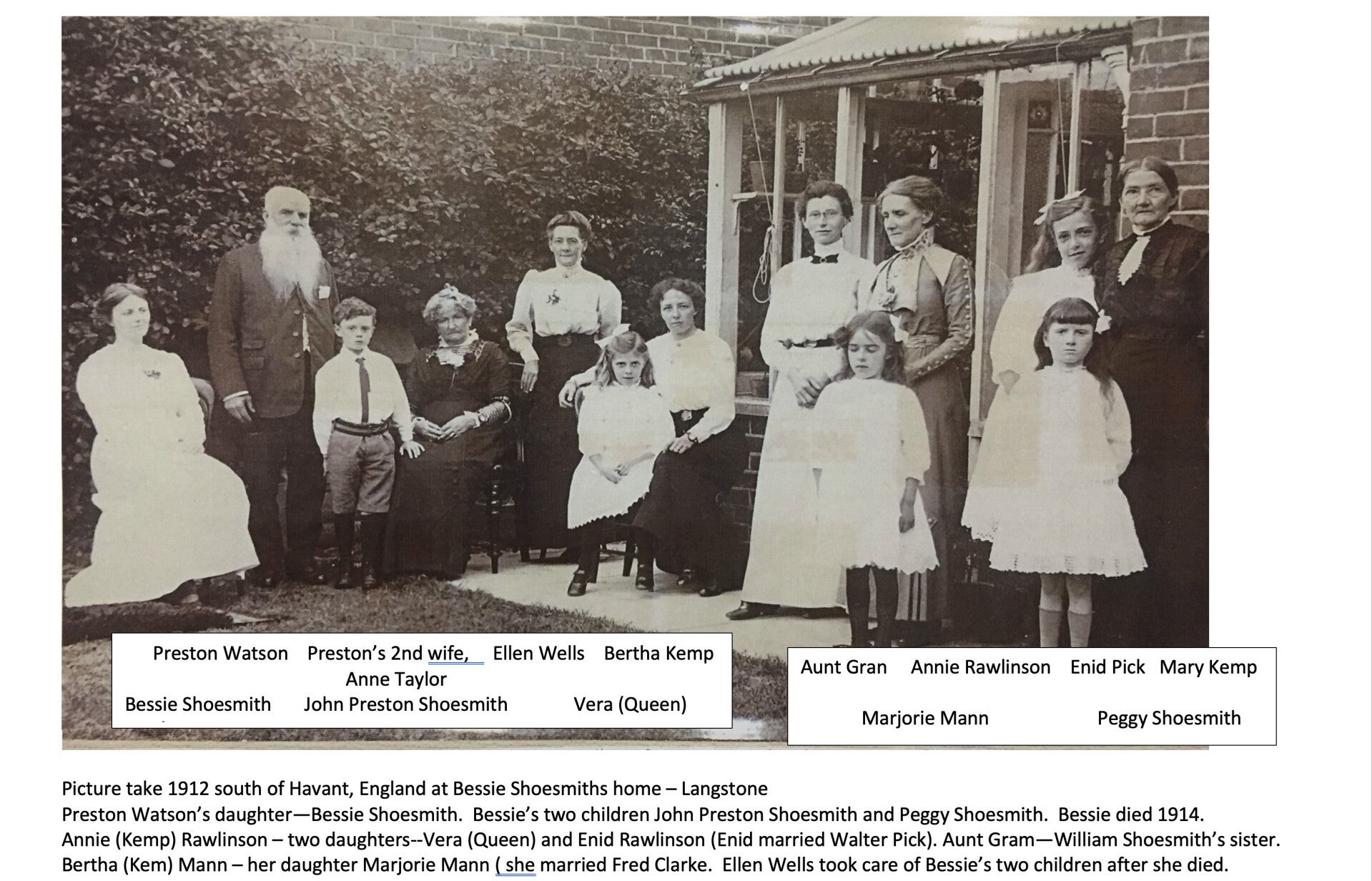
People in Photograph
Mary Kemp (nee Watson) is Preston’s sister. Her daughter is Bertha, who by then was Bertha Hann and her daughter is Marjorie Hann (not Mann as typed). Annie Rawlinson (1867 – 1941) is another of Mary Kemp’s daughters and Vera (1907 – 1975) and Enid (1903 – unknown) are her daughters and were probably just visiting, whereas the Haan’s lived in Havant.
Ellen Wells. Not clear who she is.
Aunt Gran, I assume is Catherine Shoesmith who remained in Havant after her sisters and brother John moved away and in 1911 was living in Langstone with her brother William and his wife Bessie and the two children. There is more about her in another Interesting Graves article.
Peggy Shoesmith was actually christened Elizabeth Margaret.