

Eastern Road Cemetery graves of interest
If you have found the grave of an ancestor in one of the Havant cemeteries and you have information that may be of interest to other people, please tell us using the Contact form and we will add it to this page.
Hann Family
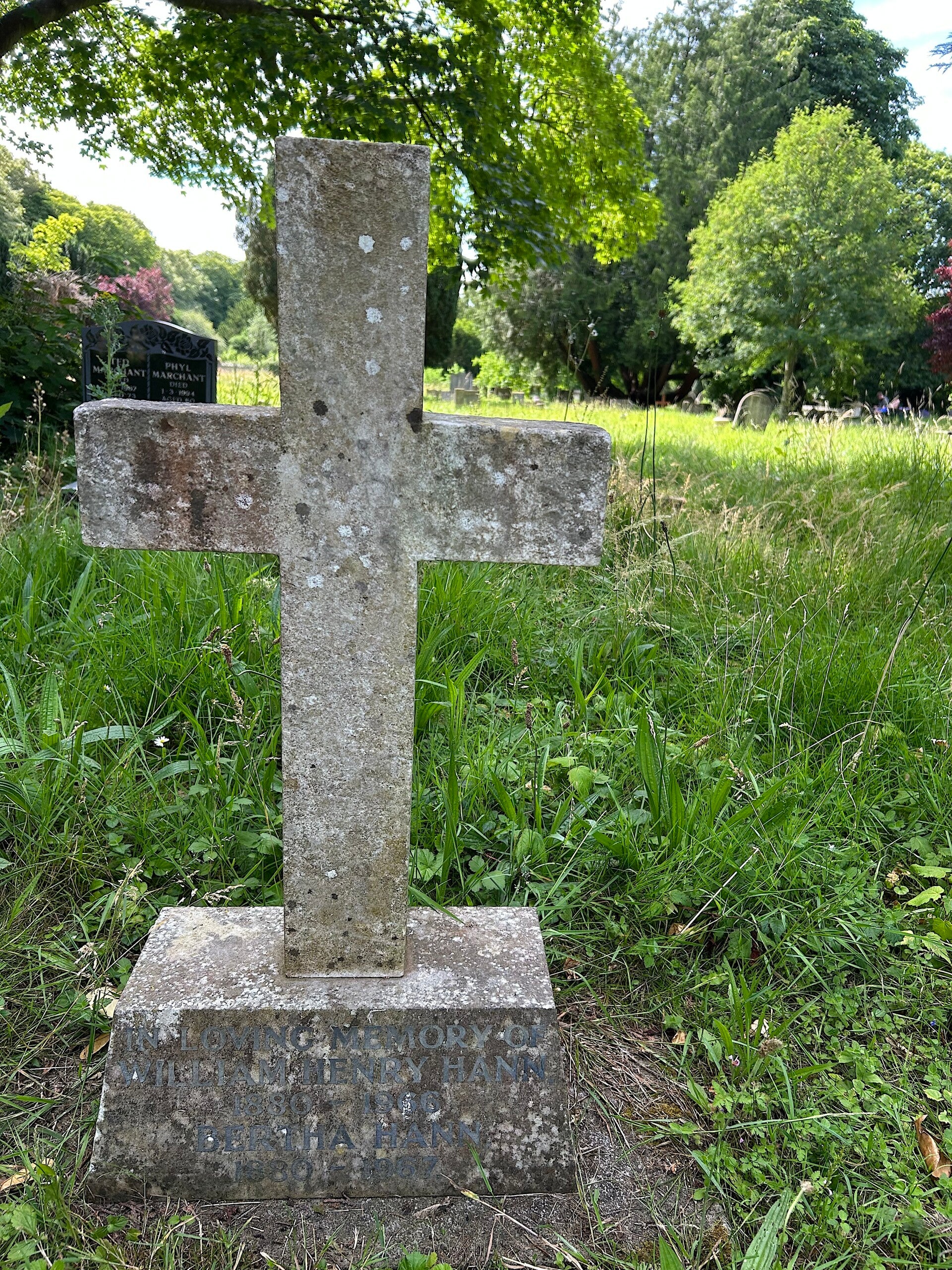
There are two Hann graves, one on either side of the Eastern Rd section.
The first is that of William Henry Hann and his wife Bertha, which lies alongside the north – south path which runs parallel to the eastern boundary wall.
Bertha Kemp, born 12th January 1880, is a daughter of Preston Watson’s sister Mary. Her first recorded appearance in Havant is in 1901, when she is living with Preston and his family at 12 North St. She then marries William Hann in the second quarter of 1906 shortly before the birth of their only child Marjorie Bertha on August 23rd. William was born in Battersea on 12th May 1880 but in 1901 along with his parents and siblings he is living at 7 Fairfield Rd, Havant. His occupation is House Furnisher’s Assistant. In 1911 William, Bertha and Marjorie are living at Hillcrest, Beechworth Rd, Havant. William is now a House Furnishers Salesman. By 1921 they have moved to 4 Grove Rd, Havant. William’s occupation remains the same though an additional item of information is, that his place of work is Victoria House, Havant. Living with them is Bertha’s mother Mary. Mary died on December 26th 1929 in Havant but was buried in Harby, Leicestershire in the same grave as her husband. W, B & M are still living at 4 Grove Rd in 1939 when William’s occupation remains the same, Bertha is shown as Incapacitated and Marjorie as a Builder’s Clerk.
William died in 1966 and was buried on November 8th. Bertha died early the next year and was buried on March 3rd. Marjorie, meanwhile, had married Frederick Edwin Clarke in Havant in 1941, following the death of his first wife the previous year. They had a son, Trevor, in 1943. It’s not clear where they lived initially but certainly in later years, they were living at 4 Grove Rd and continued to live there until their deaths; Frederick on 4th July 1988 and Marjorie on April 19th 1996. There aren’t any local burial records for them so they may have been cremated.
William’s parents are buried immediately alongside the western boundary wall of the Eastern Rd section, next to the grave of the two Bannister sisters. Henry Hann and Ruth Hawkins were both born in Montacute, Somerset in 1842. They were married at St Peter, Great Windmill St, Westminster on June 4th 1866. Henry at that point was a Commercial Traveller. In 1870 they travelled to the US via Quebec and two of their children were born in Kansas, one in 1871 and the other in 1873. They returned to England prior to the birth of their fifth child in Battersea on December 31st 1875. They were still in Battersea in 1881 when Henry’s occupation is given as Scripture Reader. In 1891 they are living in Woolwich when Henry is described as Lay Reader (with Bishop’s Licence). As mentioned above, in 1901 they were in Havant with Henry similarly described as Licensed Lay Reader. Henry died on December 9th 1906, followed by his burial on December 13th. Ruth died on June 6th 1909, followed by her burial on June 10th. Her last address was 71 West St, Havant.
More details are available on Ancestry including in “The Watsons and Shoesmiths of Havant”, author Christopher Evans.
The Robinson Family
William Robinson and then his wife Caroline ran The Perseverance in North Street for a number of years in the early 1900s. Caroline's father was a publican so she may have had the necessary experience. The grave is in the Eastern Rd section by the western boundary wall and just past the pillar that marks the end of the southern boundary of the Dissenters cemetery.

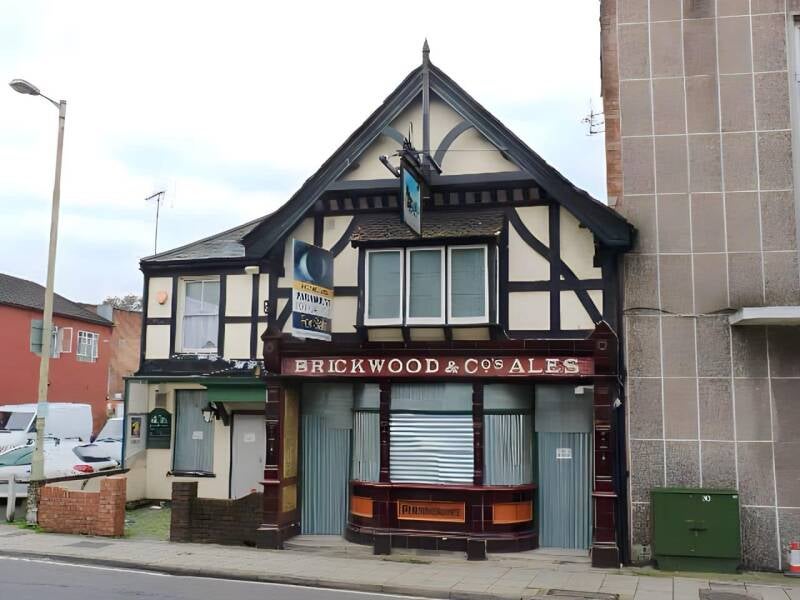
Click on the link for further reading
Bessie Amy Shoesmith
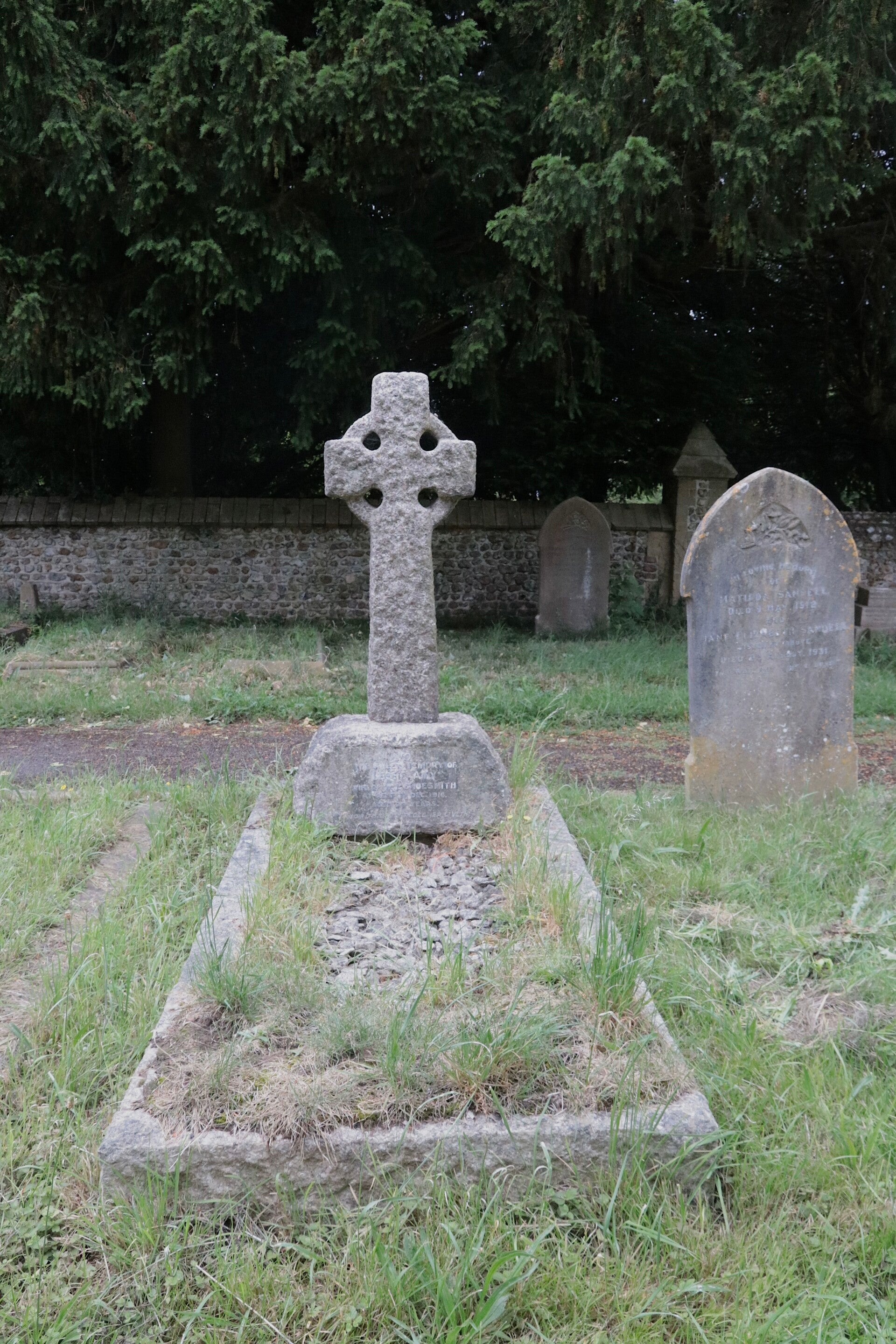
Born in Cowes, Isle of Wight in 1877, Bessie was the only daughter of Preston Watson and his wife Elizabeth Jenkins.
Bessie married William James Shoesmith in Havant in 1903. They had 2 children, John Preston born July 23rd 1906 and Elizabeth Margaret, known as Peggy, born August 23rd 1907.
Bessie died at Southover, Langstone Rd, Havant on December 31st 1916 and was buried on January 4th 1917.
For more detail go to Interesting Graves/St Faiths/Preston Watson on this site or look for The Watsons and Shoesmiths of Havant on Ancestry. Author Christopher Evans.
Catherine and Kate Shoesmith
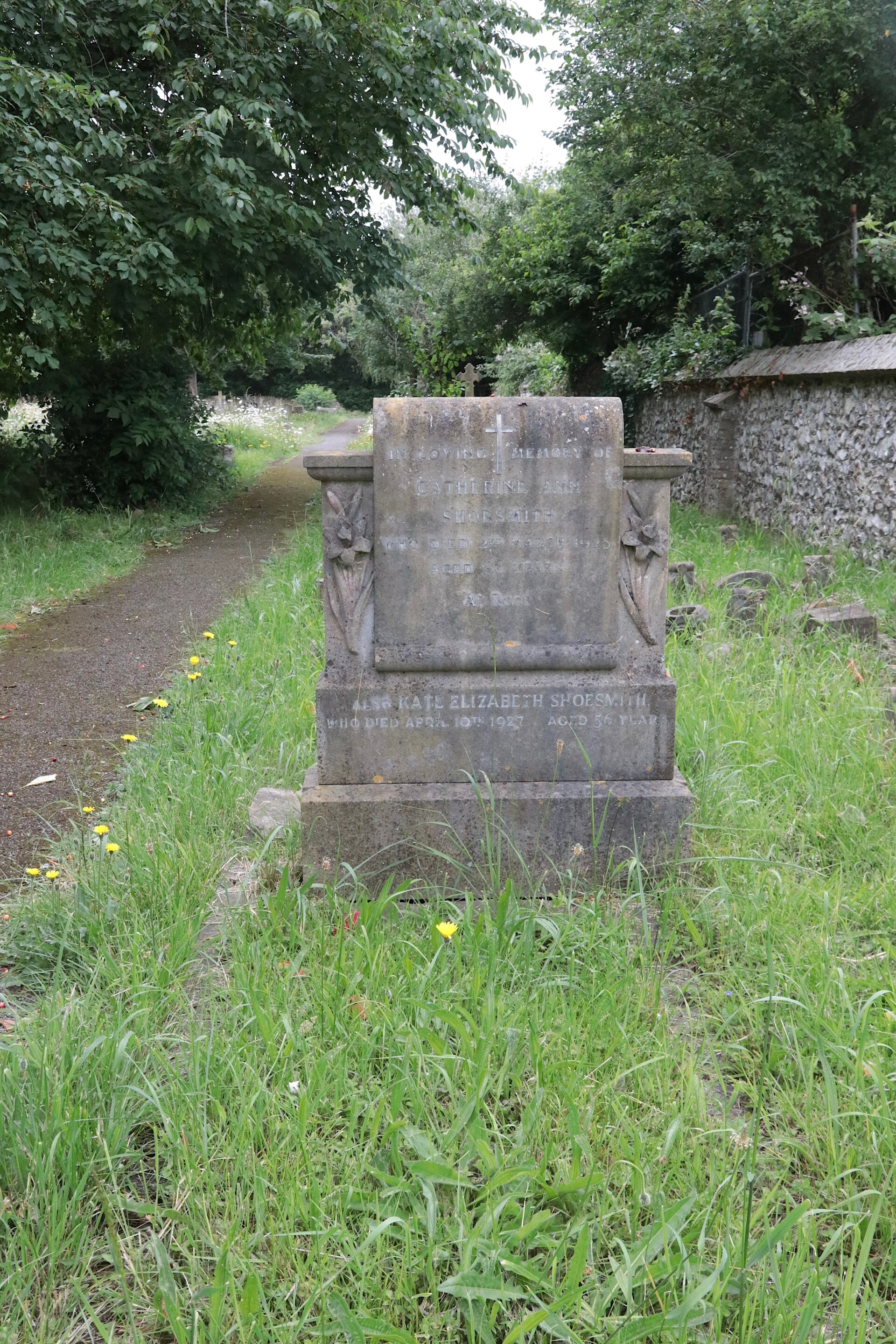
Kate and Catherine were two of the three daughters of John Shoesmith and Catherine Bryant. They were born in Lewes, Sussex in 1870 and 1875 respectively, as was the third sister, Alice, born in 1872. John was a Railway Porter in 1871 and by 1876 he had transferred to Havant. Their son John Henry was born in Havant in 1876, as was William James who was born in 1880. William later married Bessie Ann Watson, daughter of Preston Watson and details of his life from 1901 onwards can be found in Interesting Graves/St Faiths/Preston Watson.
In 1881 all the Shoesmiths are living in North St, Havant and John is Head Railway Porter at Havant Station.
1884. Death of Margaret Shoesmith, 17th July followed by a burial in the St Faith’s section of the New Lane cemetery on July 22nd.
1891. John and his children were living at No. 2 North St. John’s occupation as 1881, Kate, no occupation, Alice, dressmaker, Annie (Catherine) Dressmaker’s Apprentice, John Henry, Railway Clerk and William still at school.
1895. Death of John Shoesmith, 30th June. He had hung himself following a period of ill health which had led to a possible demotion and loss of the family home, presumably a railway property. The jury at the inquest noted that his suicide had been “accelerated by the unjust treatment he had received at the hands of the …Railway Company after so many years faithful service”. He was buried on July 5th in the St Faith’s section of the New Lane cemetery.
1901. John Henry and his sisters are living at Glebe Cottages, Leatherhead. JH still a Railway Clerk, Kate listed as Housekeeper Domestic and Alice and Catherine as Dressmakers.
1911. John Henry, Kate and Alice are living at 13 Sunnycroft Road, South Norwood, Surrey.
JH still a Railway Clerk, no occupation listed for Kate, possibly running the house and Alice is a Dressmaker. Catherine has returned to Havant and is living with William and his family (see: Interesting Graves/St Faiths/Preston Watson).
1925. Death of Catherine, 2nd March. Address at the time of death, 13 Huntley Rd, South Norwood. Burial 9th March, Eastern Rd, Havant. The grave is in the north east corner alongside the path that runs East/West.
1927. Death of Kate, 10th April. She died in Norwood Cottage Hospital, Upper Norwood. Home address, 13 Huntley Road. Burial 14th April.
1939. Alice and John Henry are still living at 13 Huntley Road; JH is retired and Alice is listed as Unpaid Domestic Duties.
1954. Death of Alice at The May Day Hospital, Croydon, 29th December. Home address still 13 Huntley Rd. No burial records.
1958. Death of John Henry at Green Gables, Vernon Hill, Bishops Waltham, 2nd January. Address probably that of his nephew John Preston Shoesmith. No burial records.
Singer Family
There is one aspect of Havant history that few people will be aware of. The parents and siblings of a (then) well-known cycle and car manufacturer, George Singer lived at Warwick Lodge, Fourth Avenue Denvilles during the last decade of the nineteenth century and until 1925, when the last survivor, Mary Singer died. The grave of George Singer (senior), Hellen Singer, Mary Singer and Arthur William Singer is in the newer part of New Lane cemetery.
The Singer Company is little known these days – it manufactured its last car as an independent concern in 1955, before being taken over by the Rootes Group
Singer Family History
Founder of the Singer marque, George Singer was born to George and Hellen Singer on the 26th January 1847 at Kingston House in the parish of Stinsford, Dorset. His parents had travelled south from Aberdeenshire to work on the Kingston Estate, as Farm Bailiff and Dairy Manager respectively, at some time following their marriage of 1845. Such working arrangements were commonplace in the nineteenth century; it would have been a tough life for the Singers, working hard on the farm and raising a family. The Kingston Estate had been purchased from William Grey Pitt in 1845 by Mr Francis Pitney Brouncker Martin, a wealthy well educated man with an inclination to experimental farming and amateur science. It is not known why the Singer family chose the Kingston Maurward Estate in Dorset; perhaps there was a connection with the Martins or they simply responded to a job advertisement.
George junior had two surviving siblings, Mary and Arthur William; sadly there is record of another, Frederick, buried in the local church, St. Michael’s Stinsford in April 1852, aged five months. The Stinsford churchyard also contains the grave of Poet Laureate Cecil Day Lewis (died 1972) and is the resting place of the heart of poet and novelist Thomas Hardy (died 1928), buried alongside the grave of his first wife Emma Lavinia Gifford who died in 1912.
Stinsford is the village ‘Mellstock’ of Hardy’s novels ‘Under the Greenwood Tree’ and ‘Jude the Obscure’. Hardy had been born on the Kingston Estate in 1840, and from the age of eight attended the village school at Lower Bockhampton near Kingston farmhouse. Francis Martin’s wife Julia Augusta taught at the school, which had opened in 1847 on land she and her husband had donated. Following a dispute between Hardy’s mother, Jemima, and Julia Martin, Hardy was taken away from the school in September 1849. George Singer junior most likely attended the school, possibly from when he was three years old. School attendance at such an early age was not uncommon in those times.
In 1851 George and Hellen Singer were employing Martha Hurden as a house servant. She was a local girl; her family lived nearby in Lower Bockhampton. Martha’s sister Fanny had been at school with Hardy but sadly she died aged 20, and in his poem ‘Voices from Things Growing in a Churchyard’ Thomas Hardy remembered Fanny, though he re-named her Fanny Hurd.
The Kingston Maurward estate was sold in 1853 to James Fellows, the ensuing departure of the Martins signalling the exit of the Singer family.
By 1861 the Singer family had moved to the interestingly named Polthooks Farm near Bosham in West Sussex, where George senior worked as farm bailiff for John Baring Esq. of Oakwood, East Ashling in the parish of Funtington. John Baring was a member of the famous Barings banking family. Baring had been born at Lee in the parish of Lewisham, not far from the Greenwich and Deptford works of famous marine engineer John Penn who built, among other things, the engines for HMS Warrior, now moored in Portsmouth Harbour. George Junior was by this time aged 14. The family’s long stay at Polthooks Farm probably gave rise to the incorrect statement, made in some publications, that George Singer was born in Sussex. Although the original Polthooks farm building remains, the farm itself has become a small business park.
Some connection with the Martins continued during the Singers’ stay at Polthooks because the census records tell us that Mary Singer, aged 21, was visiting the Martins at Broadwater, Worthing in 1871. In the subsequent (1881) census when she was home at Polthooks, her occupation is given as ‘Postal & Telegraphist Clerk’, with her brother Arthur William being recorded as ‘Cow Keeper Agricultural Labourer’.
Most members of the Singer family remained at Polthooks until at least 1891, before moving to Havant to live out their final years. However, George junior did not reside there for long, because before his 15th birthday he left the family home to become an apprentice mechanic at John Penn and Sons of Lewisham, from whence he was drawn into the sewing machine industry by Newton Wilson & Co. It would be a reasonable assumption that the connection with the Lewisham born John Baring led to young George’s move to Lewisham. At this stage it is important to establish the fact that that although George worked in the sewing machine industry for a period, there is no connection whatever with Singer sewing machines.
It’s at Lewisham that another illustrious name from the history of motoring crops up – William Hillman, born in Lewisham and like Singer employed first by John Penn and then Newton Wilson & Co. Singer and Hillman are recorded as bell ringers at the local church during their period together at Lewisham, but life must have been very full for those bright young men because they found time to ring only a single peal at their home tower in February 1867.
In 1869 George Singer moved to Coventry and in 1871 is recorded as living in Union Street, lodging at the home of George and Elizabeth Addison, his stated occupation being given by the census of that year as ‘Sewing Machine Finisher’. A fellow boarder was William Hillman, with stated occupation ‘Sewing Machine Manufacturer’. George Addison himself is recorded as ‘Sewing Machine Maker’. It is therefore probable that Singer, Hillman and Addison all worked at the Coventry Machinists Company Ltd. (earlier the Coventry Sewing Machine Company Ltd.) under works manager James Starley. This is supported by motoring journalist David Burgess-Wise who tells us that Starley had ‘head hunted’ William Hillman and George Singer from Newton Wilson & Co because of their abilities. Starley himself was an extremely able man having started out as gardener to John Penn of Lewisham; today he is considered to be the father of the cycle industry.
At this point we catch another glimpse of ‘Singer the Man’ outside the context of his work, for George became a member of Vicar Lane Chapel, a non conformist Church known as the Independents, who at some point changed their name to Congregationalists. It is probable that George went there because the Addisons attended. On 2nd February 1881 George and six others were appointed to the Finance Committee at Vicar Lane, together with the Pastor and Deacons. George himself became a Deacon on 30th March 1881.
By 1881 George Singer had married and was living at 8 Stoneleigh Terrace Coventry with his wife Eliza and three children Louise, George and Minnie. His stated occupation was ‘Manufacturer of Bicycle and Tricycle Employing 300 Men and Boys’. George was clearly prospering because he was able to employ three servants.
Softly

The Softly grave in the Eastern Road section has a link to the Palmer/Way tomb in the New Lane section. Rebecca Softly (nee Palmer) is the sister of Ann Ives Way (nee Palmer) who was buried in the tomb.
Stallard, Albert Donald Died 27th May 1915

Albert Donald Stallard was an Assistant Paymaster in The Royal Navy and was killed, aged 20, as the result of an explosion on board HMAS Princess Irene.
The Princess Irene and her sister ship the Princess Margaret were built as passenger liners in 1914 for the Canadian Pacific Railway Company and requisitioned by the Admiralty on 20th January 1915. By March the ships had been converted to fast minelayers with a capacity of 400 mines.

The Princess Irene (pictured above) was based at Sheerness and on the morning of 27th May 1915 she was moored in the River Medway, approximately three miles from Sheerness town centre. Her crew and naval personnel drafted from Chatham were preparing the ship for her third mine-laying operation in the North Sea. Additionally, civilian workers from Sheerness Dockyard were on board to strengthen the improvised gun decks. Mines were also being loaded from barges and stowed on the ship’s two mine decks. At 11.12 hours there was an explosion and the Princess Irene disintegrated. A column of flame 300-feet high was followed by smoke and further eruptions of flame above where the Princess Irene had been moored. A small steam ship and two barges lying alongside were also destroyed and a collier moored half-a-mile away downstream had its crane blown off its mountings.
Three crew members from the Princess Irene had a fortunate escape as they were ashore at the time of the explosion. There was only one survivor, a stoker who was found amongst the floating wreckage and rescued. 273 officers and men and 76 civilians perished in the explosion. Across the river, one-and-a-half miles away on the Isle of Grain, a nine-year-old girl, Ida Barden, was struck by a piece of metal and killed and a farm labourer working in a field nearby died of shock.
Wreckage fell up to twenty miles away from Sheerness. Civilians in Sittingbourne were injured by falling debris and a 10-ton section of a boiler damaged Admiralty oil storage tanks on the Isle of Grain. A box of butter landed in Rainham six miles from Sheerness.
Albert is buried with his brother, James Alan Stallard, who was a Private in the Gloucestershire Regiment and died at home, aged 19, on 26th August 1918 of wounds received in action. Their parents, Edward James and Beatrice, are in the same grave which is adjacent to the wall alongside the allotments.
Assistant Paymaster Albert Donald Stallard is commemorated on Portsmouth Naval Memorial.
James Alan Stallard is listed on the Board in Midhurst Rother College.
Sources: Wessex Western Front Association
Kent Online
Rother Valley War Memorials
Standing, George CBE DSO MC 1875 – 1966 Methodist Minister 1900 – 66
George was born on 11th November 1875 at Havant, Hampshire, to parents George Richard Standing and Emma Jane Till. His father was a local preacher, successful businessman (grocer) and Justice of the Peace.
George attended Bedhampton Sunday School and was influenced by Rev William Cuthbert to think of ministry. He entered Hartley College in 1898 and served for six years on the Aldershot Mission before the First World War.
When war broke out in 1914, George Standing immediately volunteered his services and was commissioned into the Royal Army Chaplains’ Department. He was the first Primitive Methodist minister to enlist in the armed forces and after time spent at Aldershot, organising the chaplaincy work with the army, he was sent to the front, serving with distinction in France and Italy. During the war he was mentioned in dispatches four times and was awarded the CBE, DSO and the Military Cross for bravery. He was also awarded the Order of the Crown of Italy.
By the end of the war he had been appointed the Assistant Principal Chaplain. After the war he was involved in France in the secret procedure for the selection of the Unknown Warrior. He then returned to Aldershot Garrison, and in 1929 became Deputy Chaplain General at the War Office. He was also made an Honorary Chaplain to the King. He was respected and somewhat feared in military circles because of his fight for the recognition of Free Churchmen in the services.
In retirement George returned to Havant and continued to preach in the area. Almost to the end of his life he visited weekly the cottage hospital which his parents had largely been instrumental in building. George died on 6th January 1966 at Havant, Hampshire.
